
“I created a version of life as I wanted to see it and captured it:” Interview with Michael Schuette
By Angie Nova
An OG Contagion Media member and a talented filmmaker, I am most pleased to introduce artist Michael Schuette! Originally from Tucson, Michael studied filmmaking with Contagion’s CEO, Kassandra Ramirez, at Northern Arizona University. He has since created featured films, music videos and content with Contagion Media. Join me in reading about his journey, videography style, and what it takes to make a great filmmaker.

Photo of Michael Schuette by KBR, Assisting by Angie Nova
What mediums of art do you create?
The mediums of art I create in are filmmaking, mostly. That's my primary. Photography. I love playing the guitar, and I sing but not good at all. I just like to sing in the car by myself.
How long have you been filmmaking?
The first time I ever got into any type of film project was when I was in high school. It was a class called ‘Film Acting,’ which was an extension of the theater program that I was in for 4 years. We did little music videos and recreated scenes from movies and stuff like that. Once I took that class, the rest was history. Ms. Erickson was the teacher. She was awesome.
What are some things that you do to prepare for a shoot?
It kind of depends on the project, but generally, what I would do is find what I can identify personally with on the project. If it’s like a client’s project, I have to find something that I can connect with on an intellectual/emotional level. That way I can dig deep into it, and make it something personal. If it’s for my own project, something I do to prep is sleep on it. I try to envision the end product first, then work my way backwards, if that makes sense at all.
How would you describe your videography style?
I think my videography style - the way people have described to me - has been like a documentary style. I never really saw it like that, specifically, but to other peoples’ eyes, I guess, somehow the way I move the camera is in the style of a documentary. Yeah, I don’t know if I have a videography style… I think I do have a style, I just don’t know how to describe it. It’s almost like how do you describe a feeling? You know what I mean? It’s just like, you can try to explain it, but when you see it, you get it. I don’t know.
Is there a feeling you want to portray in your videography?
Yes! What that feeling is depends on what the videos are. If I make something that’s intended to have a deep emotional thing, I want you to feel that visually. The coolest feeling is when you write or shoot a scene, and in your mind you want the audience to feel something, then you watch them watch it [the scene] and they gasp or laugh authentically. That’s the best feeling in the world, because it means that you made them feel something. Whatever I want the audience to feel, I want them to feel it raw or viscerally.
What’s your favorite thing to shoot?
When you’re working with young kids, everything that they do, no matter what movement, it’s always candid. Very fluid. Authentic. Every kid is photogenic. I almost feel like you never have to stage them. Any movement that they do is pure, honest. There’s a lot of honesty.
That makes a lot of sense, actually.
I also like filming food, because there’s a cool feeling that you get when you film or create a video project of food, and somebody watches it and they say, “Oh, that made me hungry!”That’s a really cool feeling. It’s like I made you have a feeling because of my visuals.

Photo of Michael Schuette by KBR, Assisting by Angie Nova
What are some of the best, and worst, things to shoot?
I would not say that this is one of the worst things to shoot, but what happens is sometimes you can get into a situation where you are working with somebody, and in this field of entertainment, it is very collaborative, so sometimes if you’re not in the same state of mind as somebody else, and you guys are not clicking, you kind of clash ideas.
If it gets confrontational, it can get… not very fun. I have run into situations where that’s happened with other people. That is like the worst situation because it can end up in, not in an argument, but come into a clash. It gets really tense. It can get awkward, but that is life, you know what I mean? Some of the worst situations I’ve been in have been that.
Some of the best have been, honestly, projects that I have written myself, because when you write a script and you watch actors interpret your words into themselves and bring their personalities into, it’s really cool. It’s like you created words out of thin air, and you created life out of that. I created a version of life as I wanted to see it and captured it. Showed it to other people, and made them feel something.
Would you say your family is supportive of what you do?
100%! That is one of the biggest reasons why I am able to do what I do is because of having the family’s support. Which is why when I do what I do, I do it with the younger generation of my family in mind. If I can get to a certain point to where I’ve hit my version of success, that can be the inspiration for the younger kids in my family to be, like, damn, if Michael can do it, then I can do something like that. At least, believe in myself.
What’s an important quality a videographer/filmmaker should have?
Being able to listen! Listening is huge, because it is a collaborative space. I am telling you what to do and you’re not responding, and if you are responding to me in a certain way and I am not listening to you, then we are not on the same wavelength. Being able to listen, and even listening when somebody’s not speaking words by listening and paying attention to somebody’s body language. You are directing a scene and somebody’s body language shows they are not feeling it comfortably. It’s like, okay, how can we adjust this and make it work? Then just being a listener, in general, and being an observer. What I do is take my observations and capture them in a way that my eyes see it. Constantly observing, constantly listening, constantly taking it all in.
What kind of movies do you like?
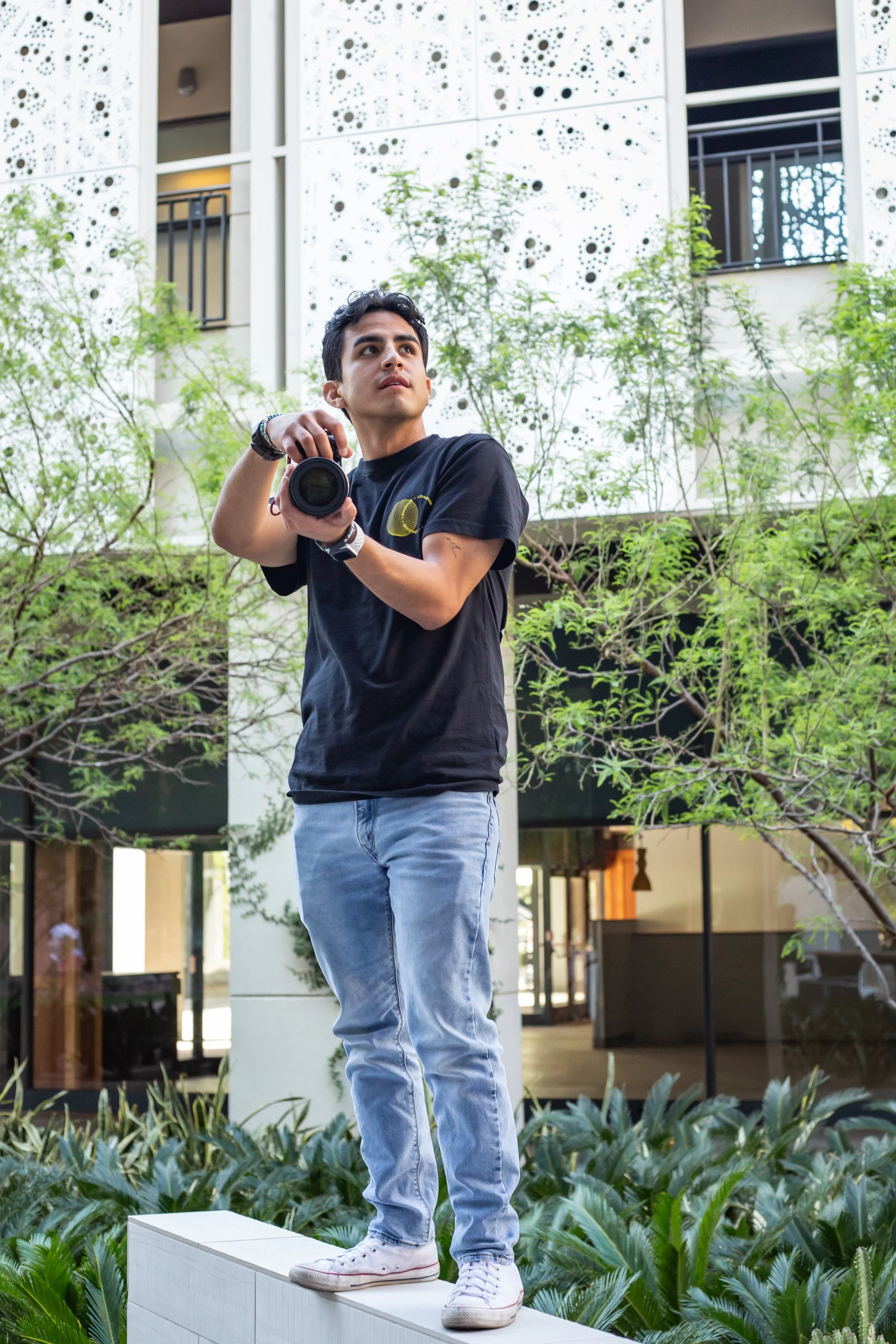
Photo of Michael Schuette by KBR, Assisting by Angie Nova
The type of movies that I like are films that take place in a short amount of time in a small amount of space. For example, ‘the Breakfast Club’ takes place in one location in a short amount of time but all of their life goes down at that library. The movie Stand by Me. These four kids go on this little journey, and it’s in a span of twenty-four hours, but when the movie starts and when the movie finishes, their entire life changes! And it’s only in a confined amount of space. That kind of thing.
Who, or what, is your inspiration?
One of my biggest inspirations - creatively - is Carlos Santana, the musician, because his music is timeless. I could listen to his music from his earliest albums to his newest stuff and hear the same richness, quality, tone and heart that he puts into it. The way he talks about music. He doesn’t talk about music like necessarily in the notes, he talks about music as a parallel with life. That is kind of how I feel about filmmaking. I just want to bring a parallel between film and life. It is a different process for sure because when you are playing the guitar, it’s instant. You hit a note, it rings out and you feel it through your ears. When music gives you goosebumps, that’s part of what I try to achieve with film.
What are your interests outside of filmmaking?
I love playing music because, like I said, it is instant. When you shoot video, it takes weeks before the final product comes out, but music is instant. The way I describe it is like when you feel congested and you can’t breathe. Then you wake up one morning and it is like, “Ah, I can breathe!” That is the feeling I get when I am playing music. If I do not play it for a while, I feel congested, then I just play and it’s just oxygen, you know what I mean?
When you say instant, do you mean instant gratification?
Instant like when I pluck a string it makes an instant note. Instant art. Filmmaking is a long tedious process. I can explain it to people, but unless you have made some type of film, beginning to end, it’s kind of hard to understand what exactly goes into it. That art process is not instant. That is how music is, though, instant. That’s part of what I like about filmmaking is that since it’s such a long process, when you get the final product, it’s like you know what went into that. You know the hours, the time, the energy. Blood, sweat and tears kind of thing.
What are some advice you would give to aspiring videographers or filmmakers?
Short films are the exact same thing as feature length films - just smaller. Start there and execute great, short films. If you can execute a great short film, you can execute a great feature length film. Get your reps in with short films. Write two pages of a short film. Another thing: If you can make somebody feel something in a scene, you can make somebody feel something in a movie. I would describe it as like short films are like poems. Feature length films are like novels. Videography, specifically, I would say honestly get your reps in with editing. Picking up the camera and shooting is one thing, putting it in editing software is different.
What is a project that you are working on currently?
A project that I am working on currently is in the early idea stages of a music video. It is this sort of indie-pop song with a rapper from Tucson that has this flow that when you listen to it, you can not help but bob your head to it. That is what we’re working on right now.
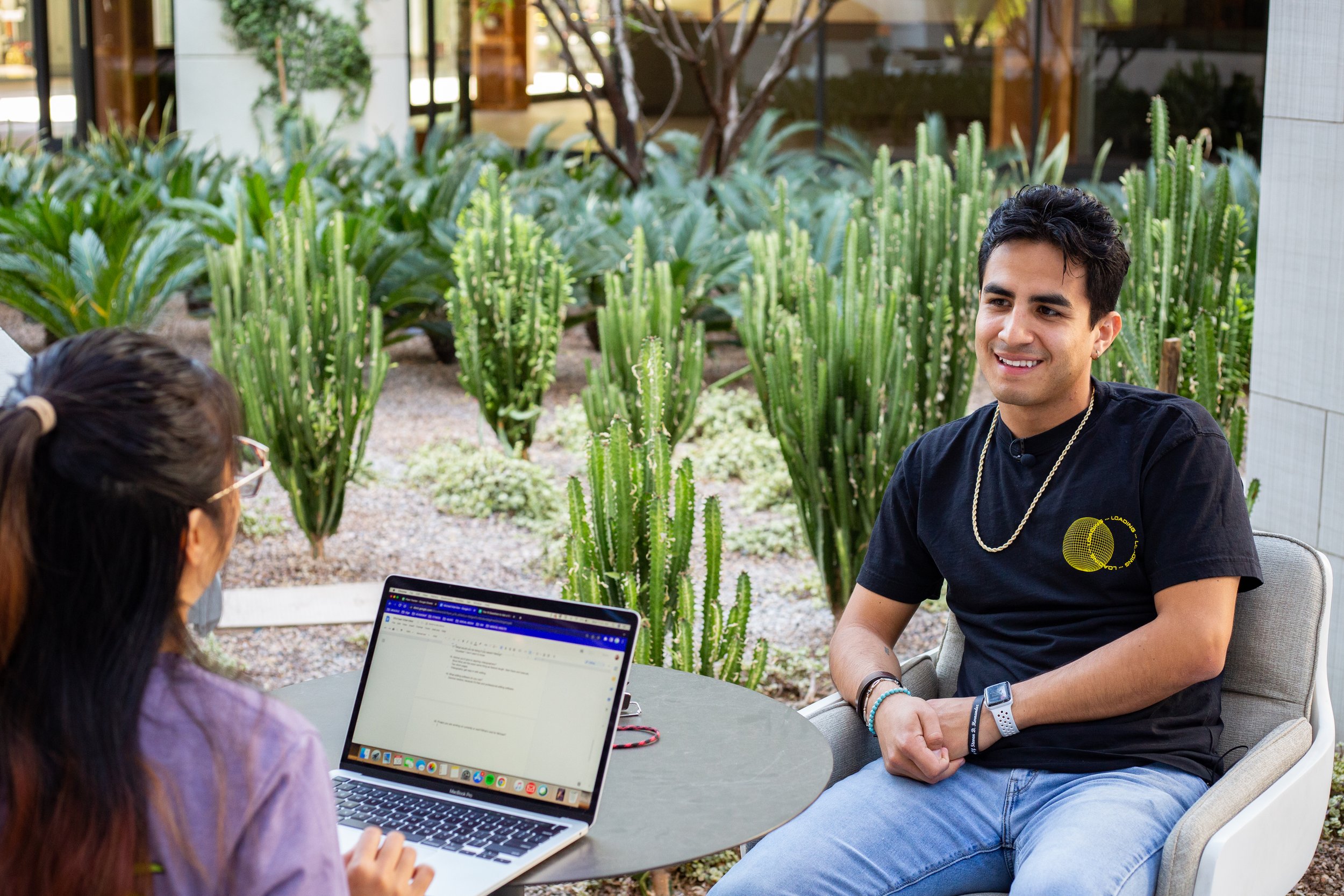
Behind the Scenes from the Interview: Photo of Michael Schuette by KBR, Interview by Angie Nova
Lastly, what does success mean to you?
Success is ever-changing, because once you reach a certain point of success, it’s like reaching checkpoints and goals. What can I do to keep getting better? Honestly, success is being able to go to sleep and feel good in what you’ve created. That can be a lot of different things. Success can be getting my LLC for my business - I went to sleep that night feeling good. Finishing a project, pressing export the film beginning to end and submitting it to get viewed by film festivals - I went to sleep that night feeling good. Success kind of depends on whatever you are working on at that time. Also, success, to me, is when somebody else tells me that I inspire them! I know that I have done something right there.